
Hans-Günter-Schäfer Science Award 2026 goes to Zrinka Duvnjak
Screenshot
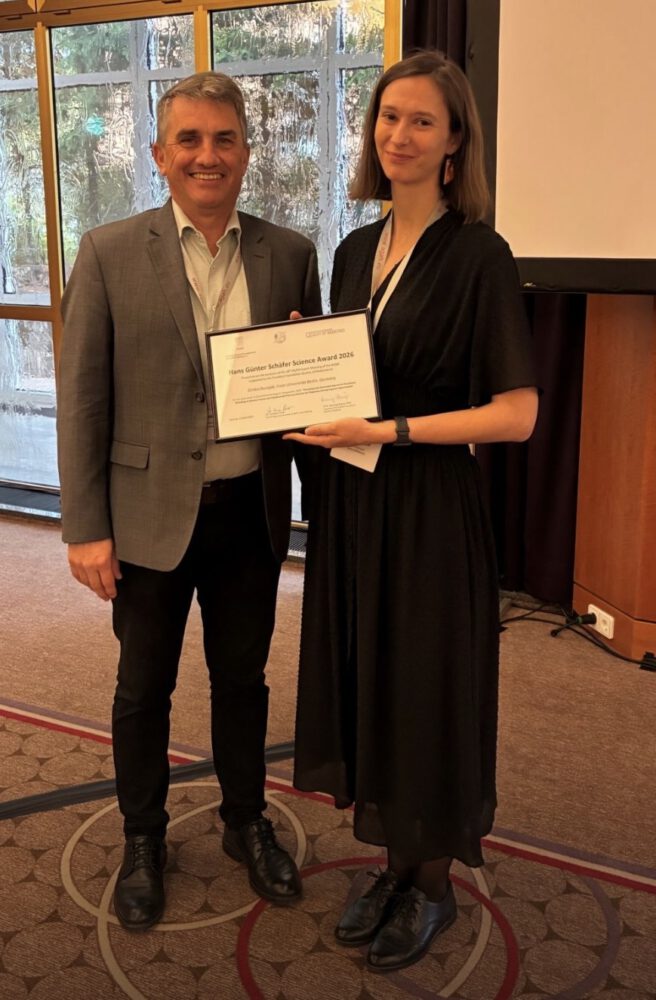
The winner of the Hans-Günter-Schäfer-Science Award 2026 is the PhD student Zrinka Duvnjak. She is in her final year of studies as Pharmacometrics PhD student at Freie Universität Berlin, Departement of Clinical Pharmacy and Biochemistry. Ms. Duvnjak is awarded for the publication „Physiolocically Motivated Sequential Population Modeling of Albumin Trends and Vedolizumab Pharmacokinetics for Pregnancy Dosing Regimen Optimization” (Clin. Pharmacol. & Therapeutics, doi:10.1002/cpt.70145). The study enhances quantitative understanding of monoclonal antibody pharmacokinetics in pregnancy using Vedolizumab as an example with potential application to other biologicals, and provides optimized dosing strategies in nomogram-like plot to mitigate risks of adverse pregnancy outcomes.
The award, which is endowed with 1,000 euros, is sponsored by the Frankfurt Foundation Quality of Medicines (FFQM). The Foundation congratulates Ms. Duvnjak and wishes her continued success in her scientific work. The award was presented on 25 April at the PKPD expert meeting in Weimar, which is organized by the Arbeitsgemeinschaft für angewandte Humanpharmakologie (AGAH)
Understanding the pharmacokinetics of drugs during pregnancy is crucial for ensuring effective treatment and maintaining disease remission—and thereby reducing the risk of adverse pregnancy outcomes.
Vedolizumab, a humanized monoclonal antibody, is approved for the treatment of inflammatory bowel disease. It has been demonstrated that vedolizumab can cross the placenta.

The present study investigated the pharmacokinetics of vedolizumab in 39 pregnant patients with chronic inflammatory bowel disease, as active disease poses the greatest risk for complications during pregnancy. Since the effects of pregnancy on monoclonal antibodies have hardly been quantified to date, the authors developed a physiologically based model to understand changes in drug concentration. A key aspect of this was the use of albumin trends as a biomarker for pregnancy-related expansion of plasma volume. The study shows that albumin levels typically decrease by nearly 27% over the course of pregnancy, which has a direct impact on the distribution and elimination of the drug in the body.
Modeling revealed that the central volume of distribution for vedolizumab increases by an average of 52.4% by the end of pregnancy. At the same time, clearance—that is, the body’s ability to eliminate the active ingredient—increases by up to 71.9% overall. Part of this increase occurs particularly in the third trimester, which may reflect the transfer of the antibody across the placenta to the fetus. These physiological changes cause the trough concentrations of vedolizumab to drop by nearly half shortly before birth, significantly increasing the risk of loss of efficacy and associated disease flares.
To maintain effective therapeutic exposure, the authors propose optimizing dosing intervals, which have been summarized in a user-friendly nomogram. For about one-third of patients, a gradual shortening of the interval between infusions is necessary to prevent levels from falling below the efficacy threshold. For example, a standard 8-week interval might be shortened to as little as 5.6 weeks toward the end of pregnancy. These results provide, for the first time, a quantitative basis for individualized treatment adjustments in pregnant women and could serve as a model for the study of other biologic drugs in this vulnerable patient group.


