

“Untargeted Profiling of Protein Pharmaceuticals” Project Successfully Completed
We congratulate Ms. Yipei Yang on the successful completion of the project “Untargeted Profiling of Protein Pharmaceuticals: Simultaneous Determination of Identity, Protein Damage, as well as Unknown By-products and Adulterations,” which was funded by the Frankfurt Foundation Quality of Medicines. She conducted this work as part of her master’s thesis and subsequent doctoral dissertation in the research group of Prof. Monika Pischetsrieder at the University of Erlangen-Nuremberg.
Protein-based pharmaceuticals have to undergo rigorous quality control, which includes verification of identity as well as detection of protein impurities, unauthorized additives, and protein damage that occur during manufacturing and storage. Non-targeted protein profiling using LC-MS/MS has the potential to simultaneously determine the identity of the drugs, as well as protein damage, contamination, and adulteration. Even minimal structural changes should be detectable.
As part of her master’s thesis, Ms. Yipei Yang therefore used untargeted protein profiling to investigate the extent to which this approach can be used to characterize the quality of commercial filgrastim preparations. Filgrastim is used to treat patients who have an immunodeficiency caused by chemotherapy or immunosuppression and is produced recombinantly in E. coli for this purpose.
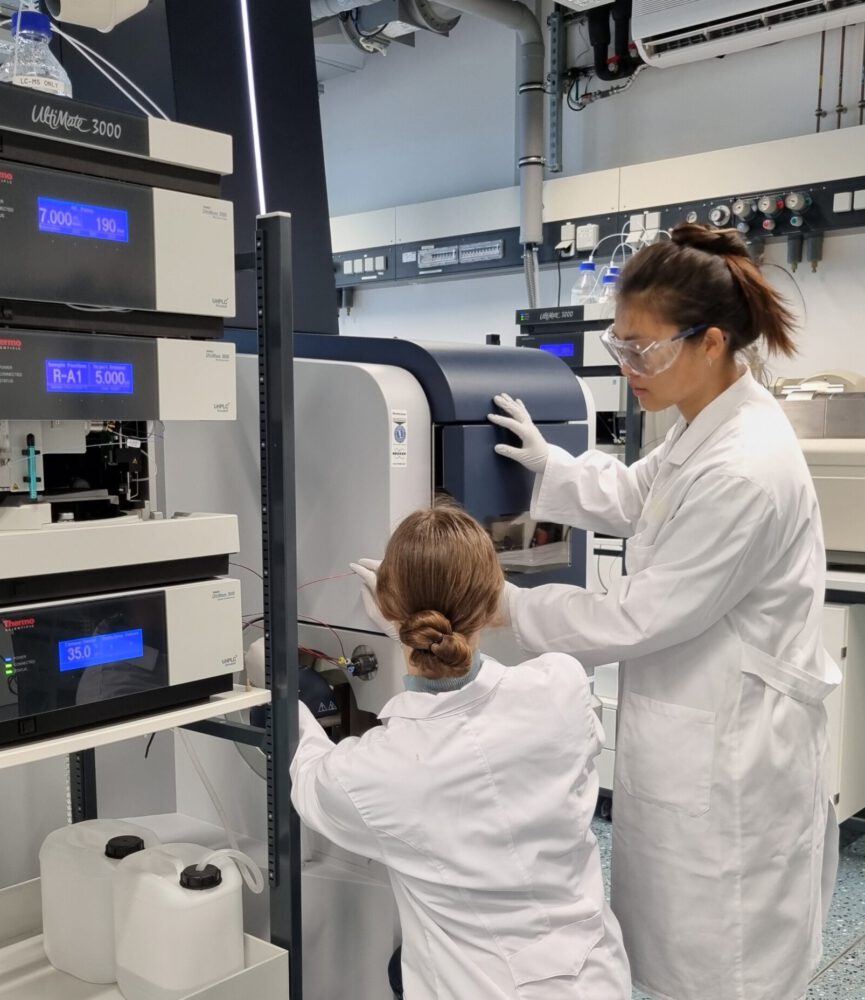
In the first part of her work, Ms. Yang optimized an LC-MS/MS method for unstructured protein profiling and the subsequent bioinformatic data analysis, thereby achieving complete sequence coverage of filgrastim. This method also allows for the detection of microheterogeneities in the protein that are difficult to identify. The complete identity of the filgrastim solution under investigation was confirmed in accordance with the reference standards of the European Pharmacopoeia.
In the second part of her thesis, Ms. Yang expanded her method to also account for post-translational modifications (PTMs) that can occur on amino acid side chains due to chemical reactions during production and storage.
By using a customized PTM database and applying a newly developed manual filtering workflow, the occurrence of false-positive results was minimized. This method can detect 53 process-induced PTMs that can occur at 15 different sensitive amino acid side chains. To further validate the method and assess the significance of the detected protein damage, Ms. Yang conducted additional stress tests. Under oxidative stress conditions, oxidations of methionine, tryptophan, and cysteine residues in filgrastim were detected. Glycation stress selectively affected individual lysine residues, and alkaline stress led to the deamination of glutamine residues.
As a result, the study succeeded in developing a non-directional LC-MS/MS method for protein profiling that can simultaneously verify the identity and protein quality of a protein-based drug. The method was developed for the active ingredient filgrastim but can now be easily adapted to other protein-based active ingredients. In ongoing studies, the method is currently being further developed to detect foreign proteins as well as residues from the host organism E. coli. Thus, non-directional protein profile analysis will enable the simultaneous determination of four key quality parameters (identity, protein damage, adulteration, and impurities) of protein-based pharmaceuticals.
The study was conducted at the Chair of Food Chemistry at Friedrich-Alexander University Erlangen-Nuremberg and at the Mass Spectrometry Equipment Center @FAU NeW under the direction of Prof. Dr. Monika Pischetsrieder by Ms. Yang, with support from Lena Riedinger and Dr. Sabrina Gensberger-Reigl, in cooperation with the deputy director, Dr. Tobias Borst of the University Hospital Erlangen Pharmacy.


