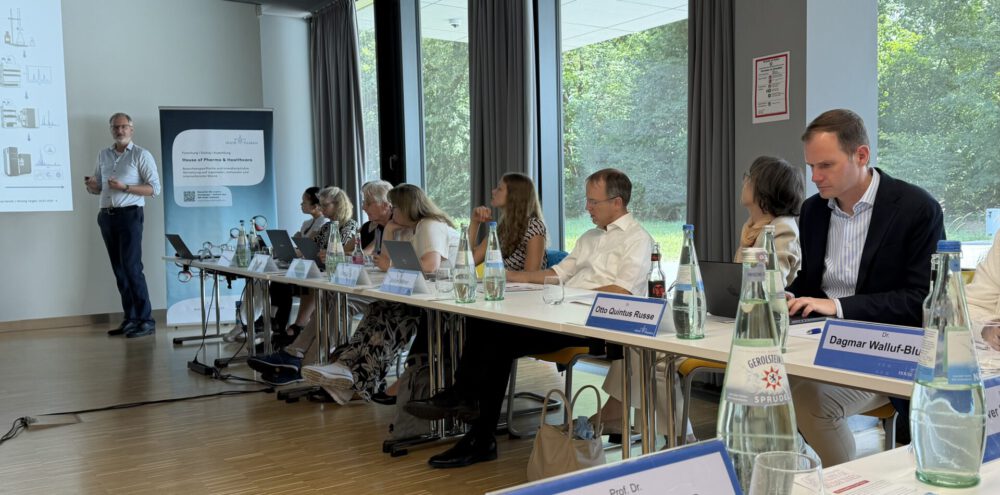
Expertmeeting „Pharmaceutical Analytics—Current Status and Outlook(s): Small Molecules, Biotech Products & Nanomedicines“
 On July 16, 2026, experts from academia, industry, and government agencies gathered at the Fraunhofer Institute for Translational Medicine and Pharmacology (ITMP) in Frankfurt am Main for the expert meeting titled “Pharmaceutical Analytics—Current Status and Outlook(s): Small Molecules, Biotech Products & Nanomedicines.” The event was hosted by the House of Pharma & Healthcare and the Frankfurt Foundation Quality of Medicines. Prof. Dr. Manfred Schubert-Zsilavecz and Prof. Dr. Henning Blume opened the meeting on behalf of the two institutions. Discussions focused on current analytical and regulatory challenges for ensuring the quality of finished pharmaceutical products throughout their entire product lifecycle. The central question was how pharmaceutical analytics can continue to guarantee quality, safety, and trust in the face of increasingly complex products, manufacturing processes, and data volumes.
High-resolution mass spectrometry and other modern techniques enable increasingly precise characterization of molecular structure, even for highly complex pharmaceuticals such as biologics and nanomedicines. However, as analytical capabilities expand, a tension arises between technological progress and regulatory classification. What is technically possible is not necessarily relevant to quality assurance. At the same time, established regulatory requirements may not be sufficient to adequately address all new risks associated with these complex product classes.
Moderated by Prof. Dr. Manfred Schubert-Zsilavecz and Prof. Dr. Stefanie Kaiser, participants from universities, pharmaceutical manufacturers, and regulatory agencies discussed how to address the future opportunities and challenges in pharmaceutical analytic.
The following is a summary of the topics covered and the discussions that took place.
Purity as an evolving Quality Criterion
The discussion initially focused on drug purity throughout the entire product lifecycle. It became clear that „purity“ is not a static quality criterion that can be definitively established upon approval. Changes in the synthesis or manufacturing processes, as well as changes in excipients or their suppliers, could influence a product’s purity profile.

Using the valsartan case as an example, it was discussed that testing methods targeting known impurities could overlook unexpected risks. So-called non-targeted methods are often suitable for uncovering such “blind spots,” but they do not automatically provide answers that are usable for regulatory purposes. Anomalous signals must be identified, confirmed, quantified, and evaluated toxicologically. In the experts’ view, targeted methods therefore remain the basis of routine quality control but should be supplemented in a targeted manner by non-targeted methods in the event of changes products.
Biosimilars: How similar are they really, and when are they similar enough?
The discussion then turned to protein analytics and biosimilars. Modern mass spectrometry, structural biology methods, and functional assays now enable a much more precise comparison of originator products and biosimilars than was possible ten or even twenty years ago.
This raised specific regulatory questions for the panel of experts. For example, the discussion addressed whether the more comprehensive analytical characterization now possible—and the resulting demonstrable, extensive comparability of the products (“biosimilars” vs. “originals”)—could justify a reduction in the scope of clinical trials. At the same time, not every analytically detectable deviation is automatically clinically or toxicologically relevant. A risk-based assessment of theirsignificance for quality, efficacy, and safety remains crucial.
Nanomedicines – at the limits of what can be measured
The focus was also on nanomedicines, a product class where traditional analytical categories reach their limits. These cannot be characterized solely on the basis of the active ingredient’s chemical identity. Rather, it is crucial to identify additional quality attributes that are reliably linked to stability, efficacy, and safety.
For many parameters that can be determined in vitro, however, it is unclear how reliably they can predict a product’s behavior within the body. It was also pointed out that nanomedicines could alter their properties in a biological environment, for example through interactions with blood components or proteins. As long as in vitro properties could not be clearly linked to in vivo effects, product-specific evaluations and supplementary clinical studies would generally remain necessary for this product class.

Future Concepts in Pharmaceutical Analytics – Platform Technologies and Artificial Intelligence.
Finally, the focus turned to quality assurance for oligonucleotide-based therapeutics and mRNA vaccines. In particular, platform-based concepts for their analysis and quality control were discussed. For similar products (e.g., resulting from a minor “adjustment” of the mRNA in a flu vaccine to match the current viral specification), existing validation data could be partially utilized within the framework of such approaches. This would prevent analytical testing and quality control from becoming a time-critical bottleneck for market launch in the case of rapidly adaptable products. New vaccines, such as those against seasonal virus variants, could thus be made available more quickly. Questions regarding regulatory acceptance and the criteria for platform-compatible products were discussed.
Finally, the focus shifted to the use of artificial intelligence (AI) in analytics. While AI offers potential for structural elucidation, data analysis, and risk prioritization, high-quality training data remains a critical bottleneck.
Presentation of the Lifetime Achievement Award
The meeting concluded on a festive note with the presentation of the Frankfurt Foundation Quality of Medicines Lifetime Achievement Award to Dr. Joachim Ermer. (This was previously reported here.)
Statement
A statement titled “Pharmaceutical Analysis—A Cornerstone of Quality Control” is currently being prepared, summarizing the key findings and conclusions as well as the resulting recommendations and calls to action from the expert panel. It is currently being reviewed and coordinated with the meeting participants.